 Odolog
How to Calculate Fuel Economy: mpg, km/L and L/100 km
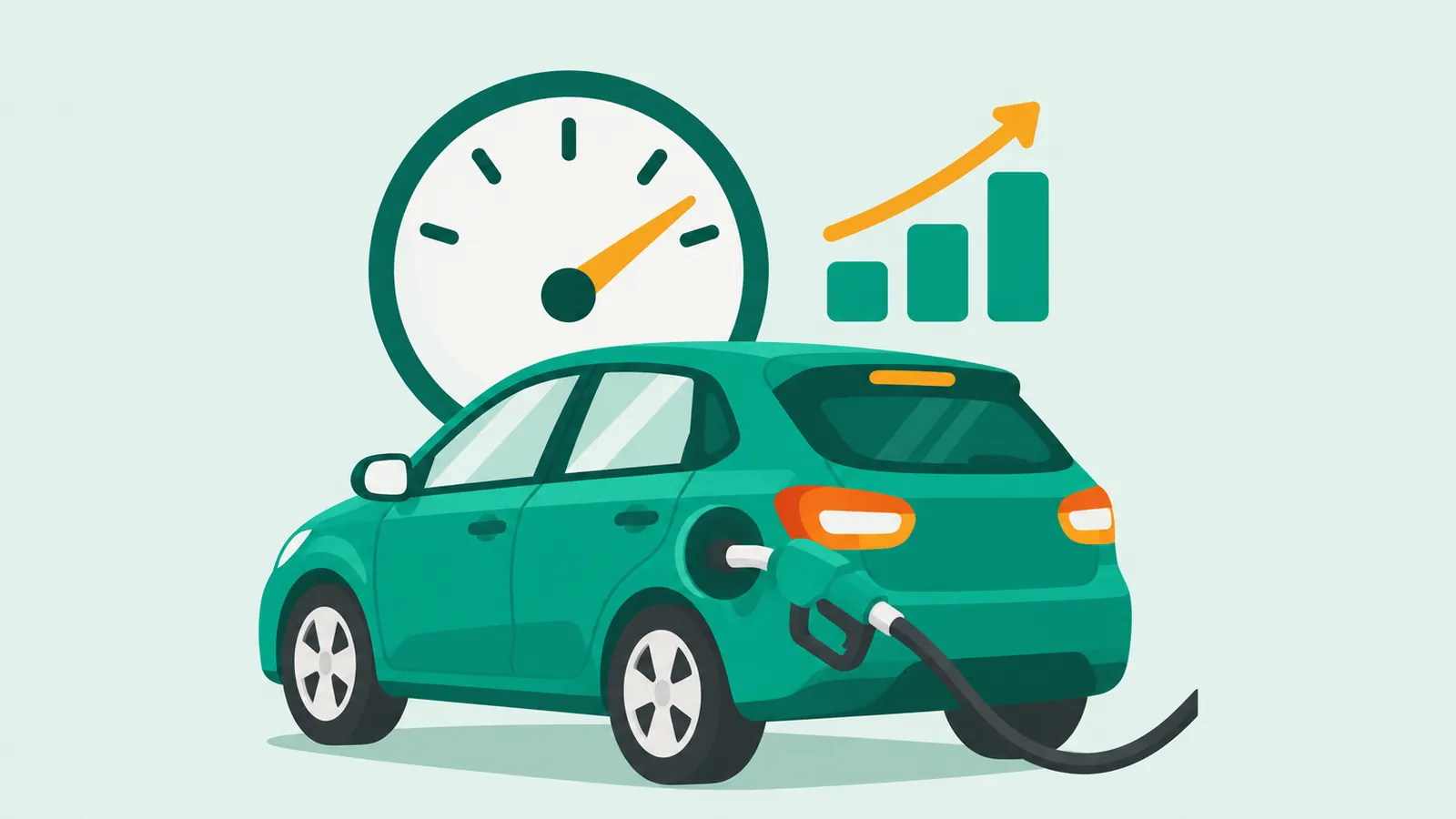
The fuel economy figure on your dashboard is an estimate, and the figure in the brochure was measured in a lab. If you want to know what your car really uses, which is the number that matters for your budget and for spotting problems early, you need to work it out from your own fill-ups. It takes two numbers and a division.
The full-to-full method
This is the method every serious fuel log uses, because it doesn't depend on the fuel gauge or the trip computer.
- Fill the tank completely, until the pump clicks off. Note the odometer reading (or reset a trip meter).
- Drive normally until you need fuel again.
- Fill completely again, the same way. Note the odometer and how much fuel went in.
- Divide: the distance since the last full tank, and the fuel you just added, give your economy for that tank.
The fuel you add at the second fill is exactly what the car used since the first, because both times you stopped at "full". Let the pump click off once and stop there rather than topping up to the brim, so "full" means the same thing each time.
The formulas
Which number you use depends on where you live. The UK and US use miles per gallon, but they use different gallons. Most of Europe uses litres per 100 km, and much of Asia and Latin America uses kilometres per litre.
With mpg and km/L, higher is better. With L/100 km, lower is better, because it measures consumption rather than economy.
Worked example in miles
You filled up at 24,180 miles and again at 24,498 miles, adding 10.6 US gallons.
Worked example in kilometres
You drove 412 km between full tanks and added 31.5 litres.
Converting between units
A US gallon is 3.785 litres; a UK (imperial) gallon is 4.546 litres. That's why the same car shows a higher mpg figure in a British review than an American one.
| From | To | Calculation |
|---|---|---|
| mpg (US) | L/100 km | 235.21 ÷ mpg |
| mpg (UK) | L/100 km | 282.48 ÷ mpg |
| km/L | L/100 km | 100 ÷ km/L |
| km/L | mpg (US) | km/L × 2.352 |
| km/L | mpg (UK) | km/L × 2.825 |
| mpg (US) | mpg (UK) | mpg × 1.201 |
So the 13.1 km/L car above does about 30.8 mpg in US gallons, 37.0 mpg in UK gallons, and 7.6 L/100 km.
Partial fill-ups
Real life isn't always full-to-full. Sometimes you put in $20 or 15 litres because the queue is long or the price is high. That's fine, as long as you don't calculate economy from a partial fill on its own. Instead:
- Log the partial fill (the amount added) as normal.
- At the next full fill, add up all the fuel since the previous full tank, including the partials.
- Divide the total distance across that whole span by the total fuel.
Example: full tank at 10,000 km; 15 L partial at 10,250 km; full again at 10,520 km with 22 L. Distance is 520 km, fuel is 15 + 22 = 37 L, so economy is 520 ÷ 37 = 14.1 km/L. Calculating from the last fill alone (270 km on 22 L) would give 12.3 km/L, which is wrong.
Missed fill-ups
If you forget to record a fill-up, the chain breaks: you no longer know how much fuel was used over that distance. Don't guess. Mark the next entry as following a missed fill-up and start a fresh full-to-full span from the next full tank. One lost tank barely affects your long-run average; a made-up number does.
Why your number differs from the dashboard
- Trip computers often read a little optimistic. They estimate fuel from injector timing, and many err on the generous side.
- Odometers aren't perfect, and worn or non-standard tire sizes change how far the car thinks it's gone.
- Pumps stop at slightly different points, so one tank can look unusually good and the next unusually bad. Look at the average over several tanks rather than any single one.
What affects your fuel economy
If your numbers drift down over a few months, something has changed. Common causes:
- Under-inflated tires: one of the easiest fixes. Check pressures monthly against the sticker in the door frame.
- Speed: aerodynamic drag rises steeply above about 55–60 mph (90–100 km/h).
- Short trips and cold weather: a cold engine runs rich until it warms up.
- Roof boxes and racks, even empty ones.
- Air conditioning, heavy loads and long idling.
- Maintenance problems: a clogged air filter on older engines, dragging brakes, worn spark plugs or a faulty sensor. A sudden drop worth 10% or more is worth a mechanic's look.
Electric cars
EV efficiency works the same way with different units: kWh/100 km (lower is better) or miles per kWh (higher is better). Use the kWh delivered by the charger, which is what you pay for. It's typically higher than what reaches the battery because of charging losses, so expect it to be a bit worse than the car's own display.
Let an app do the arithmetic
Doing this on a calculator works, but it's easy to drop a partial fill or mix up gallons. Odolog does full-to-full economy automatically: enter any two of quantity, price and total and the third fills in, mark whether the tank was full, and it handles partial and missed fill-ups for you. It works in mpg (US or UK), km/L, L/100 km and kWh/100 km, and charts the trend so a sudden drop stands out.
Once you know what you spend on fuel, the next step is the rest of the bill: see what your car really costs per mile.