 Odolog
How Often Should You Change Your Oil? Miles, Kilometres and Months
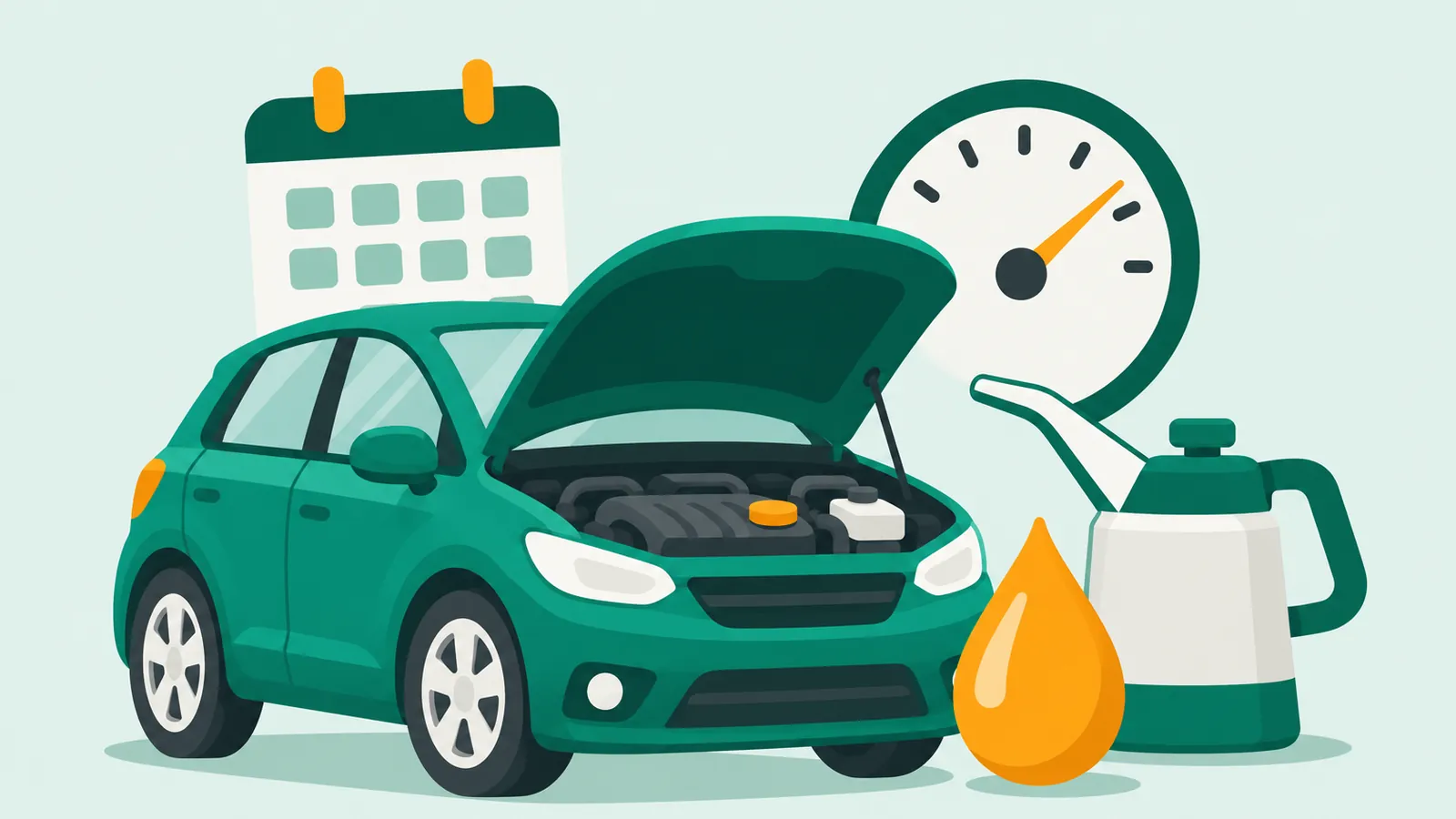
Ask three people how often to change your oil and you'll get three answers: every 3,000 miles, every 5,000, "whenever the light comes on". The honest answer is that it depends on your engine, the oil it uses and how you drive, and that the old 3,000-mile rule wastes money on most modern cars.
This guide shows you how to find the right interval for your car, when to change it sooner, and how to make sure it actually happens.
The short answer
For most cars built in the last 15 years, the manufacturer's interval is somewhere between 5,000 and 10,000 miles (8,000 to 16,000 km), with a time limit of 6 or 12 months, whichever comes first. Some cars with long-life oil and an oil-life monitor go further. Older cars and engines that run on conventional oil usually sit at the lower end.
The only number that really matters is the one in your owner's manual or service booklet. Look for the "maintenance schedule" section: it gives a distance and a time limit, and often a separate "severe" schedule.
| Situation | Typical interval |
|---|---|
| Modern car, synthetic oil, mixed driving | 7,500–10,000 mi (12,000–16,000 km) or 12 months |
| Older car or conventional oil | 3,000–5,000 mi (5,000–8,000 km) or 6 months |
| Severe use (short trips, towing, dust, extreme heat or cold) | Often about half the normal interval |
| Car with an oil-life monitor | When the monitor says, but at least once a year |
| Motorcycle | Usually shorter than a car; check the manual |
These are typical ranges, not a substitute for your manual. Turbocharged and high-performance engines often have shorter intervals than the family car next to them.
Why the 3,000-mile rule stuck around
Thirty years ago, engine oils broke down faster and engines ran dirtier, so 3,000 miles was sensible. Today's synthetic and synthetic-blend oils resist heat and oxidation far better, and engines are built to tighter tolerances. Manufacturers stretched their intervals accordingly. The 3,000-mile sticker on your windscreen is often a habit of the shop that put it there, not a requirement of your car.
Changing oil too early doesn't harm the engine, but it costs you money and time for no benefit. Changing it too late is the expensive mistake.
Why the time limit matters as much as the distance
If you drive less than about 5,000 miles (8,000 km) a year, the month limit will come up before the mileage does, and it's easy to ignore. Don't. Oil ages even when the car sits still. Short trips are worse than they sound: the engine never gets hot enough to boil off moisture and unburnt fuel, which collect in the oil and turn it acidic and sludgy.
That's why manufacturers say "or 12 months, whichever comes first". A car that does 3,000 miles a year still needs its oil changed every year.
When to change it sooner: severe driving
Most manuals list a severe-service schedule. Many drivers fall into it without realising. You probably count as severe if you regularly:
- Make trips shorter than about 5 miles (8 km), especially in cold weather
- Drive in stop-and-go city traffic or spend a lot of time idling (taxi, delivery and ride-share work counts)
- Tow a trailer or carry heavy loads
- Drive on dusty, gravel or unpaved roads
- Drive in very hot or very cold climates
If several of these apply, follow the severe schedule, which is often around half the normal distance.
Synthetic vs conventional oil
Use the oil your manual specifies: the viscosity grade (for example 0W-20 or 5W-30) and the approval or specification it lists. If the manual calls for synthetic, conventional oil isn't a cheaper equivalent, and on some engines using the wrong specification can affect your warranty.
Synthetic oil lasts longer and protects better when cold, which is why it's paired with longer intervals. But the interval comes from the manufacturer, not the bottle: "up to 15,000 miles" printed on the oil doesn't override your car's schedule.
Oil-life monitors
Many newer cars calculate oil life from engine revolutions, temperature, trip length and other data, then tell you when it's time. They're generally reliable and can save you unnecessary changes. Two caveats:
- The monitor estimates how worn the oil is. It doesn't measure how much oil you have. Engines can burn oil between changes, so still check the level.
- The monitor only works if it was reset at the last change. If you bought the car used, you can't be sure it was.
Check the level between changes
Once a month, or every other fill-up, check the dipstick with the car on level ground and the engine off for a few minutes. Pull it out, wipe it, push it fully back in, pull it out again and read the level between the two marks. Top up with the same oil if it's near the bottom. Some newer cars have no dipstick and show the level in the dashboard menu instead.
If the oil pressure warning light comes on while driving, pull over safely and switch off the engine. That light means low pressure, not "service due soon", and driving on can destroy the engine within minutes.
Don't judge by colour alone. Fresh oil darkens quickly, and diesel oil turns black almost straight away. That's normal and doesn't mean the oil is worn out.
Don't forget the filter
Most schedules change the oil filter at every oil change. A clogged filter can go into bypass, letting unfiltered oil circulate. It's a cheap part; replace it every time unless your manual says otherwise.
How to never miss an oil change
The trouble with "every 10,000 km or 12 months" is that you have to track two things at once, and the stickers on your windscreen fade or get forgotten. A reminder that watches both is far more reliable.
- Write down the odometer and date at every oil change, along with the oil grade and whether the filter was changed.
- Set a reminder by distance and by date. In Odolog you set "every 10,000 km or 12 months" and it estimates the due date from how much you actually drive, then notifies you a week before.
- Log the change when it's done. The next reminder schedules itself from that odometer reading.
Keeping that record also builds a service history buyers trust when you sell the car.
Frequently asked questions
Is it bad to go a little over the oil change interval?
Going a few hundred miles over once won't hurt a healthy engine. Making a habit of stretching intervals will, gradually, through sludge and wear. Treat the interval as a deadline, not a suggestion.
Do I need to change oil if I barely drive?
Yes, at least once a year (or whatever time limit your manual gives). Oil degrades with time and short trips, not only with distance.
Does a new car need an early first oil change?
Most modern cars don't, and the manufacturer's schedule already accounts for running-in. Some performance cars do call for an early first service, so check the manual.
For the rest of your car's regular jobs, from tire rotations to brake fluid, see our car maintenance schedule.